
Local Plan Main Modifications Consultation
Policy 6: Renewables and Low Carbon Energy Generation
| Local Plan page number | Policy or paragraph Local Plan | Proposed Change | Justification |
|---|---|---|---|
|
72 |
Policy 6: Criterion 3 |
Wind Energy Development 3: New wind energy developments and repowering of existing turbines [added] will be supported in areas identified as suitable on Map 15, or where they involve the repowering of existing turbines provided that [removed] provided that: [added] i The location, scale and design of the proposal conform with criteria (3i-iii) [removed] 1 (i-iv) [added] of this policy |
Effective Consistent with national policy |
|
72 |
Policy 6: Criterion 3 (ii) |
Any unacceptable [removed] significant adverse impacts, such as noise nuisance, shadow flicker, overshadowing or overbearing, and interference with telecommunications, air traffic operations and MOD safeguarding areas are satisfactorily mitigated |
Effective |
|
72 |
Policy 6: Paragraph 7.29 |
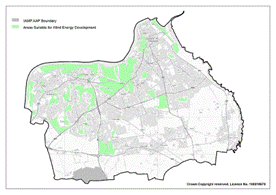
7.29 Policy 6 seeks to identify areas potentially suitable for new wind energy development. The areas identified in Map 15 are proposals at this stage. Proposals for wind energy development in these areas would be assessed against national and local policies. [removed] |
Effective Consistent with national policy |
|
74 |
Inset Map 15 |
[removed] |
Effective Consistent with national policy |
|
75 |
Policy 6: Paragraph 7.26
|
In the context of local planning policy, ‘very special circumstances’ refer to unique conditions that justify development in areas designated as Green Belt, which are typically inappropriate for new construction. These circumstances require a demonstration that the potential benefits of the development significantly outweigh its adverse impacts on the Green Belt, and any other harm, if applicable. Local planning authorities exercise discretion in determining whether these circumstances exist, and the decision maker must consider the overall planning balance in accordance with national policy. [added] |
Effective Consistent with national policy |
What to consider when making a representation
What are the tests of soundness and legal compliance?
The purpose of the examination is to consider whether the local plan complies with relevant legal requirements for producing local plans, including the duty to cooperate, and meets the national tests of ‘soundness’ for local plans set out in the National Planning Policy Framework (NPPF).
Therefore, representations submitted at this stage must only be made on these grounds and, where relevant, be supported with evidence to demonstrate why these tests have not been met.
Legal compliance
To be legally compliant the plan has to be prepared in accordance with the duty to cooperate and legal and procedural requirements, including the 2011 Localism Act and Town and County Planning (Local Planning) (England) Regulations 2012 (as amended).
Soundness
The inspector conducting the examination in public has to be satisfied that the local plan is ‘sound’; namely that it is:
• Positively prepared – the plan should be prepared based on a strategy which seeks to meet objectively assessed development and infrastructure requirements, including unmet requirements from neighbouring authorities where it is reasonable to do so and consistent with achieving sustainable development.
• Justified – the plan should be the most appropriate strategy, when considered against the reasonable alternatives, based on proportionate evidence.
• Effective – the plan should be deliverable over its period and based on effective joint working on cross-boundary strategic priorities, and
• Consistent with national policy – the plan should enable the delivery of sustainable development in accordance with the policies in the NPPF.