
Local Plan Main Modifications Consultation
Policy 18: Affordable Housing
| Local Plan page number | Policy or paragraph Local Plan | Proposed Change | Justification |
|---|---|---|---|
|
92 |
Policy 18: Criterion 4 |
4. The exact type and tenure of affordable housing to be provided on site should be identified through discussions with the Council, the latest Government guidance, and the following requirements: i. On sites with an overall affordable housing requirement of 25% or more, 25% of all affordable housing to be delivered as First Homes.[removed] The remaining [removed] affordable housing requirement should be delivered according to a tenure split of 75% affordable rent and 25% affordable home ownership (a combination of First Homes and Discount Market Sales Homes); [added] ii. On sites with an overall affordable housing requirement of 20% or less, 25% of all affordable housing to be delivered as First Homes, after which [removed] priority will be for delivery of affordable rent, subject to satisfying the national planning policy requirement for at least 10% of the total number of homes to be available for affordable home ownership. |
Justified Effective |
|
93 |
Policy 18 Criterion 3 |
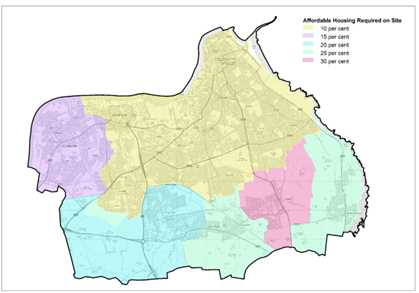
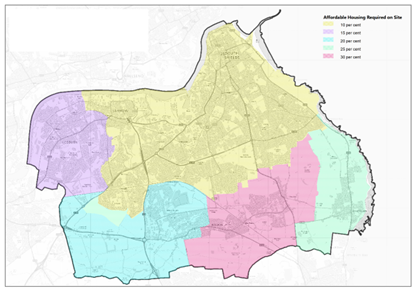
As shown on Map 22, [added] development of new housing of 10 units or more, or on a site of 0.5ha or more, shall deliver a minimum:
|
Justified Effective |
|
94 |
Policy 18: Paragraph 8.53 |
8.53 The typology testing results for the ‘Local Plan Viability Testing’ report (2023) shows that different locations in the borough can sustain different levels of affordable housing. The report concludes that the following levels of affordable housing provision are reasonable: • Cleadon and East Boldon [added] – 30% • East Boldon and [removed] Whitburn Village – 25% • West Boldon, Boldon Colliery – 20% • Hebburn – 15% • South Shields, Jarrow – 10% |
Justified Effective |
|
94 |
Policy 18 Inset Map 22 |
[removed]
[added]
|
What to consider when making a representation
What are the tests of soundness and legal compliance?
The purpose of the examination is to consider whether the local plan complies with relevant legal requirements for producing local plans, including the duty to cooperate, and meets the national tests of ‘soundness’ for local plans set out in the National Planning Policy Framework (NPPF).
Therefore, representations submitted at this stage must only be made on these grounds and, where relevant, be supported with evidence to demonstrate why these tests have not been met.
Legal compliance
To be legally compliant the plan has to be prepared in accordance with the duty to cooperate and legal and procedural requirements, including the 2011 Localism Act and Town and County Planning (Local Planning) (England) Regulations 2012 (as amended).
Soundness
The inspector conducting the examination in public has to be satisfied that the local plan is ‘sound’; namely that it is:
• Positively prepared – the plan should be prepared based on a strategy which seeks to meet objectively assessed development and infrastructure requirements, including unmet requirements from neighbouring authorities where it is reasonable to do so and consistent with achieving sustainable development.
• Justified – the plan should be the most appropriate strategy, when considered against the reasonable alternatives, based on proportionate evidence.
• Effective – the plan should be deliverable over its period and based on effective joint working on cross-boundary strategic priorities, and
• Consistent with national policy – the plan should enable the delivery of sustainable development in accordance with the policies in the NPPF.