
Local Plan Main Modifications Consultation
Policy SP16: Housing Supply and Delivery
| Local Plan page number | Policy or paragraph Local Plan | Proposed Change | Justification | ||||||||||||||||||||||||||||||||||||||||||||||||||||||||
|---|---|---|---|---|---|---|---|---|---|---|---|---|---|---|---|---|---|---|---|---|---|---|---|---|---|---|---|---|---|---|---|---|---|---|---|---|---|---|---|---|---|---|---|---|---|---|---|---|---|---|---|---|---|---|---|---|---|---|---|
|
84 |
Policy SP16 |
To meet housing needs over the plan period from 2023 to 2040, provision will be made for at least 5253 new homes and associated infrastructure. This will be phased in a stepped trajectory as follows: [added]
The Council will work with Partners and landowners to deliver South Tyneside’s overall housing requirement of 5253 net additional dwellings [removed] and maintain a rolling five-year land supply. This will be achieved by:
|
Justified Effective Consistent with national policy |
||||||||||||||||||||||||||||||||||||||||||||||||||||||||
|
84 |
Policy SP16: Supporting text |
As identified in Policy SP2, and in line with the NPPF, the Strategic Housing Market Assessment (SHMA) has identified an overall housing requirement for the Plan period (1st April 2023 to 31st March 2040) of 309 dwellings per annum. This produces an overall minimum housing requirement of 5,253 new homes. Policy SP16 seeks to ensure that the housing need for the borough is met. A stepped trajectory is being adopted, with a lower rate of housing delivery for the first five years of the Plan period, before a step up in delivery over the remainder of the Plan period. This will support the delivery of the Plan’s spatial strategy including larger strategic site allocations that have required Green Belt alterations and sites that require more complex mitigation. A stepped trajectory also reflects the fact that housing supply has been constrained in the early years of the Plan period. [added] Housing Supply There are several sources of housing supply that can contribute to meeting the housing need: Completions and Commitments The Plan base date is April 2023 for housing completions and commitments (planning permissions). A proportion of the new houses the borough needs are already committed and are either under construction or have planning permission but have not yet started on site. Lapse Rate It is possible that some of these commitments will not come forward during the Plan period for a variety of reasons such as abnormal costs (e.g. contamination) or a lack of house builder interest. Non-delivery of some of these commitments could affect the Plan’s ability to meet the identified housing need. The Plan accounts for a lapse rate of 10% for commitments on site which are not yet under construction. Projected Demolitions/Loss South Tyneside has previously experienced relatively high levels of demolitions because of housing stock clearance and regeneration. There are, however, no further large-scale demolitions anticipated which can be planned for. Similar to windfall sites, the nature of demolitions and net losses to housing stock can be unpredictable. However, it is appropriate to account for a nominal loss attributable to demolitions going forwards as they can unexpectedly come forward through the planning process. As plans for demolitions within the next two years are largely known through discussions with the Council’s Housing Strategy team, it is considered appropriate to account for unknown demolitions from year 3 onwards. As there are no plans to carry out any further major clearance, for the remainder of the plan period, an allowance of 11 [removed] 7 [added] demolitions per year from year 3 are included, this being the historic average (when excluding the large‐scale demolitions as part of council renewal programmes). Windfalls Over the past five years, there have been an average of 113 windfall dwellings delivered each year. However, given the progression of the Local Plan and the thoroughness of the SHLAA assessment, it would be unreasonable to assume that these levels of windfall delivery will continue. The SHLAA accounts for a windfall rate of 37 dwellings per year from year 6 onwards. Browfield Register The Brownfield register identifies sites which are less than 5 dwellings. These are expected to be delivered during the Plan period. Residual Housing Requirement Taking the sources of supply set out above into account, Table 2 sets out the calculation used to determine how many houses the Council must plan for and allocate specific housing sites across the borough. This equates to a residual housing requirement target of 3443 [removed] 3439 [added] (Table 2). Table 2 Residual Housing Requirement
[removed]
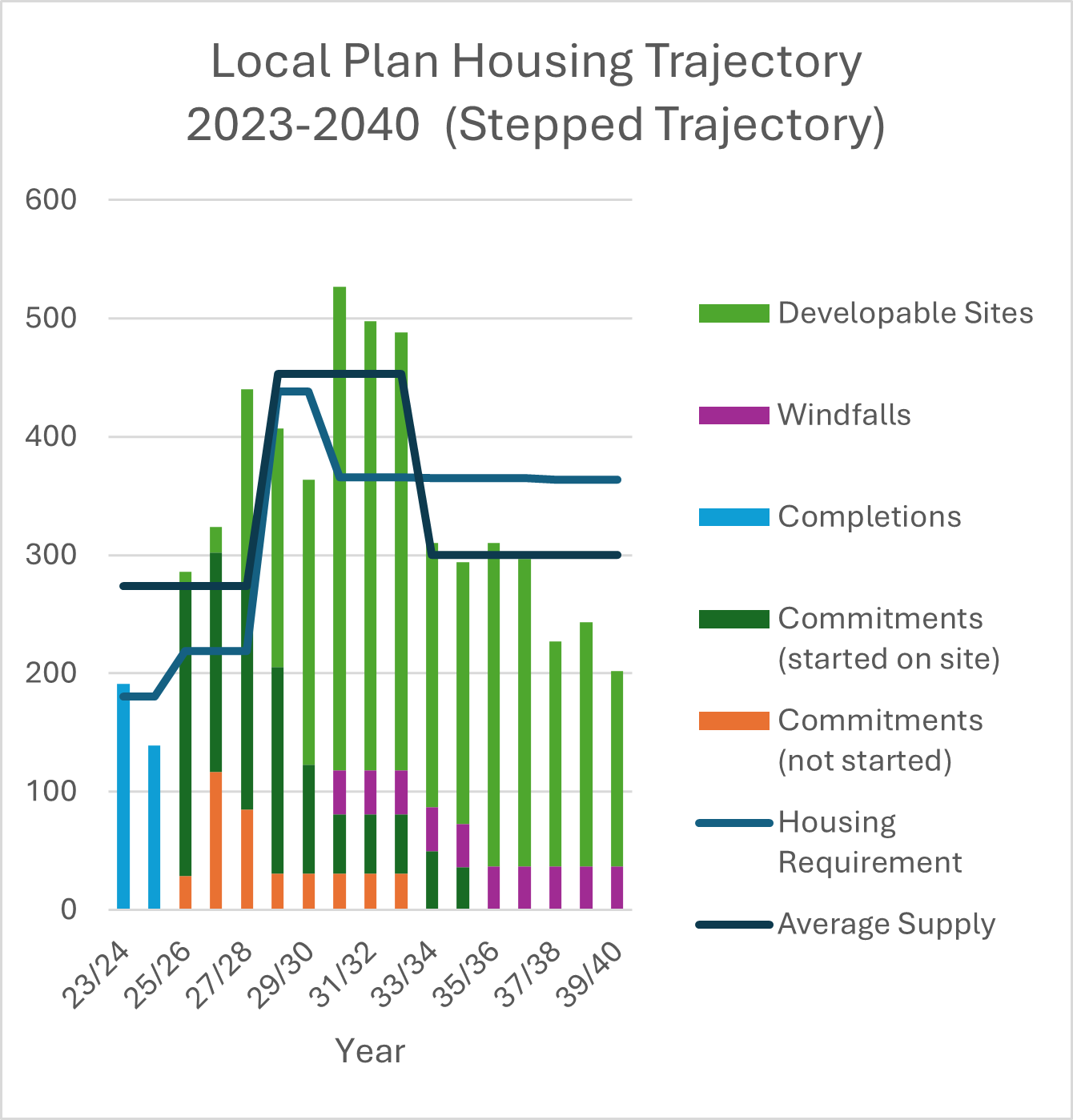
[added] Housing Allocations Supply The Plan needs to allocate sites to accommodate at least 3443 [removed] 3439 [added] new homes during the plan period. Chapter 5 identifies Housing Allocations that would accommodate 3498 [removed] up to 3634 [added] new dwelling during the period. Housing Delivery The Council must maintain a sufficient supply of housing land over the Plan period to ensure the delivery of the overall housing requirement as outlined in Policy SP16 and maintain a rolling five-year supply of deliverable housing sites, including appropriate buffers. A housing trajectory (updated to April 2025) is shown in Appendix 6. [added] It is anticipated that housing sites will be delivered in accordance with the housing trajectory shown in Figure 2. Housing trajectories are a planning tool designed to illustrate the expected rate of housing delivery across the Plan period. To prepare the housing trajectory, the Council has estimated the projected build out rates for all existing housing commitments and allocated sites. It is important to emphasise that the housing trajectories are not intended to produce perfect forecasts of the future but do provide as good an understanding as possible of the prospects for delivery. If it becomes apparent that a five-year deliverable supply cannot be evidenced or that housing delivery is falling below the thresholds prescribed by the Housing Delivery Test over a rolling three year period, the Council will implement remedial action(s) to address any shortfalls. Depending upon the scale and nature of either under supply or under delivery, actions may include:
Figure 2 Housing Trajectory
[removed]
[added] Neighbourhood Plans Housing Requirement The NPPF states that within the overall requirement, strategic policies should also set out a housing requirement for designated neighbourhood areas which reflects the overall strategy for the pattern and scale of development and any relevant allocations. The NPPF notes that, where it is not possible to provide a requirement figure for a neighbourhood area, an indicative figure can be provided if requested by the neighbourhood planning body. The Plan has identified an indicative figure for the neighbourhood areas based on the latest evidence of local housing need and the Plan's spatial strategy and allocations. This neighbourhood housing requirement is a minimum and therefore Neighbourhood Plans can include additional allocations.
|
Justified Effective |

What to consider when making a representation
What are the tests of soundness and legal compliance?
The purpose of the examination is to consider whether the local plan complies with relevant legal requirements for producing local plans, including the duty to cooperate, and meets the national tests of ‘soundness’ for local plans set out in the National Planning Policy Framework (NPPF).
Therefore, representations submitted at this stage must only be made on these grounds and, where relevant, be supported with evidence to demonstrate why these tests have not been met.
Legal compliance
To be legally compliant the plan has to be prepared in accordance with the duty to cooperate and legal and procedural requirements, including the 2011 Localism Act and Town and County Planning (Local Planning) (England) Regulations 2012 (as amended).
Soundness
The inspector conducting the examination in public has to be satisfied that the local plan is ‘sound’; namely that it is:
• Positively prepared – the plan should be prepared based on a strategy which seeks to meet objectively assessed development and infrastructure requirements, including unmet requirements from neighbouring authorities where it is reasonable to do so and consistent with achieving sustainable development.
• Justified – the plan should be the most appropriate strategy, when considered against the reasonable alternatives, based on proportionate evidence.
• Effective – the plan should be deliverable over its period and based on effective joint working on cross-boundary strategic priorities, and
• Consistent with national policy – the plan should enable the delivery of sustainable development in accordance with the policies in the NPPF.